
One Door for Foreign Workers: Foreign Worker Utilization Plan Approval and Stay Permits Now Integrated through the Online Single Submission System
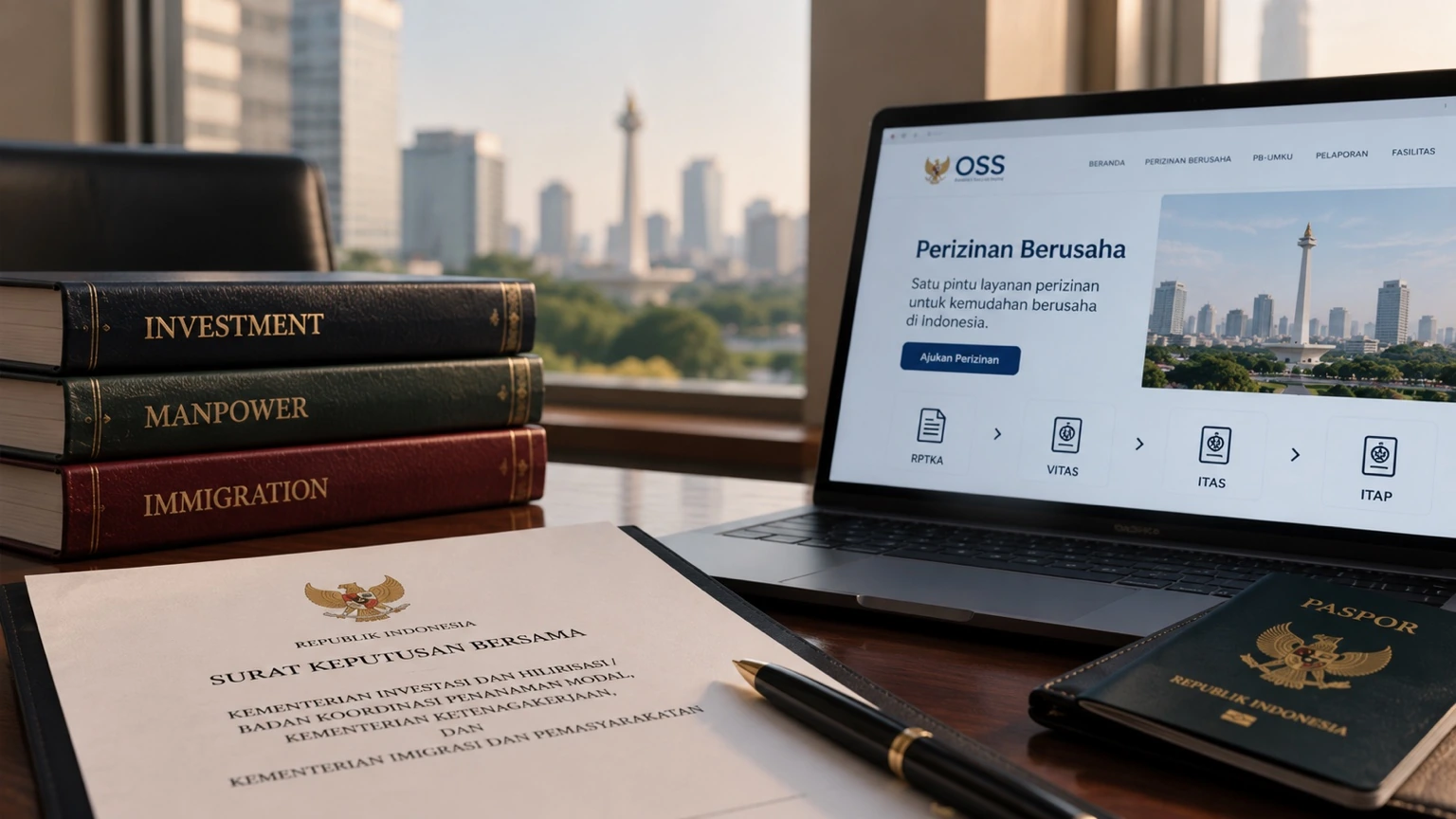
On 9 September 2026, the Minister of Manpower, the Minister of Immigration and Corrections, and the Minister of Investment and Downstreaming/Head of BKPM jointly issued Joint Decree Number 1 Tahun 2026, MIP-GR.07.02-11 Tahun 2026, and 253.S Tahun 2026 concerning foreign worker utilization plan approval and stay permits.
ABOUT THE REGULATION
This Joint Decree establishes the integration of three government systems: the Online Single Submission (OSS) System administered by the Ministry of Investment and Downstreaming/BKPM, the Manpower Service Information System and Application (SIAPkerja) administered by the Ministry of Manpower, and the All Indonesia Application administered by the Ministry of Immigration and Corrections.
Through this integration, the Government seeks to provide greater ease, time certainty, and transparency in the approval of Foreign Worker Utilization Plans (RPTKA) and applications for Limited Stay Visas (VITAS), Limited Stay Permits (ITAS), and Permanent Stay Permits (ITAP), while also improving public services and supporting Indonesia’s investment attractiveness.
The integrated framework applies to foreign workers in the context of investment, particularly investors, experts, directors, and commissioners. While the three systems are now interconnected, each ministry continues to exercise its respective authority within the approval and immigration processes.
COMPARISON
This Joint Decree does not revoke or amend any previous regulations. Rather, it introduces a more integrated service flow by positioning the OSS System as the single entry point for business actors. Under this arrangement, the relevant ministries remain responsible for their respective stages of the process and continue to use their designated systems. The integration therefore primarily changes how the services are accessed and connected, rather than altering the existing allocation of authority among the ministries, as outlined below:
| Agency | Role | System |
| Ministry of Investment and Downstreaming/BKPM | Single-entry service provider and integration gateway | OSS |
| Ministry of Manpower | Feasibility assessment and issuance of RPTKA approval | SIAPkerja |
| Ministry of Immigration and Corrections | Verification and approval of VITAS, ITAS, ITAP | All Indonesia |
KEY POINTS TO NOTE
Under the integrated framework, applications for RPTKA approval and VITAS, ITAS, and ITAP are submitted through the OSS System as the single entry point. Once the relevant approvals are issued, the issuance data for both RPTKA and immigration permits will flow back into OSS, allowing businesses to monitor their application status through a single system.
A notable feature of the Joint Decree is the introduction of a positive fictitious mechanism. If the applicable Service Level Agreement (SLA) is exceeded, RPTKA approval will be issued automatically through SIAPkerja, while approvals for VITAS, ITAS, and ITAP will be issued automatically through the All Indonesia Application. However, the Joint Decree does not prescribe specific SLA durations, which remain subject to the applicable provisions of each respective agency.
The integration also extends to the management and security of information exchanged between the systems. Data submitted through the integrated process is to be handled in accordance with personal data protection requirements, user authentication measures, and applicable information security standards.
LEGAL CONSEQUENCES
The Joint Decree primarily serves as a coordination framework among the relevant ministries and does not introduce new sanctions for business actors. Its focus is on integrating the administrative processes and systems involved in foreign worker and immigration services, rather than creating new substantive obligations.
Accordingly, existing obligations and sanctions relating to the employment of foreign workers and immigration remain applicable under the relevant underlying regulations, including Government Regulation Number 34 of 2021 on the Use of Foreign Workers and Law Number 6 of 2011 on Immigration, as amended.
EFFECTIVE DATE
The Joint Decree was stipulated in Jakarta on 9 September 2026 and took effect on the same date, without any transitional provisions. While the framework is already in effect, its technical implementation will be carried out by a dedicated Implementation Team responsible for integrating the OSS, SIAPkerja, and All Indonesia systems. The Implementation Team itself will be formally established through a separate Joint Decree.
OTHER MATTERS RECOMMENDATION
Beyond the integration of service access, the Joint Decree also provides for the exchange and utilization of data across the relevant systems, with each ministry remaining the data owner of the information it issues. To ensure the integration continues to operate effectively, monitoring and evaluation will be conducted at least once every six months. The costs associated with implementing the integration will be borne by the respective budgets of each ministry, as provided under the Ninth Dictum of the Joint Decree.
RECOMMENDATION
In light of the integrated framework, companies should ensure that the information recorded in their OSS accounts, particularly details relating to directors, commissioners, and shareholders, remains accurate and up to date. Companies should also closely monitor the technical rollout of the integrated systems and any implementing guidelines issued by the Implementation Team before submitting new applications, as these developments may affect how the integrated process operates in practice.